
Property accounting · Lancaster · UK-wide
Specialist accounting for property investors, landlords and developers.
Property accounting isn't just bookkeeping with a different label. From SPV structures and capital gains timing to rental income tax and development project accounts — you need an accountant who understands property from the inside, not one who treats it as a standard set of accounts.

- Landlords
- Buy-to-let & HMO
- Investors
- Portfolio & SPV structures
- Developers
- Project & development accounts
- Book author
- 15-chapter property tax guide

Finalist — Tax Team of the Year (Small Firm)Accounting Excellence Awards 2026
- CIMA qualified
- AAT qualified
- Fixed fees, agreed on the call
- Business & property
- Lancaster · UK-wide
Who we work with
Built for every type of property investor.
Whether you have one rental property or a multi-entity development portfolio — we understand the accounting and tax challenges at every stage.
Landlords
Buy-to-let & HMO landlords
- Single & multiple rental properties
- HMO licensing & compliance
- Section 24 mortgage interest
- Allowable expense claims
- Self-assessment tax returns
- Rental income planning
Portfolio investors
Property investors & SPV structures
- SPV & holding company accounts
- Inter-company transactions
- Portfolio restructuring advice
- Capital gains tax planning
- Director loan accounts
- Annual accounts & CT returns
Developers
Property developers
- Development project accounts
- Revenue vs capital treatment
- VAT on construction
- CIS contractor management
- Lender draw-down reporting
- Exit & profit extraction planning
SA & holiday lets
Serviced accommodation & holiday lets
- Serviced accommodation tax treatment
- Post-FHL rule changes (2025)
- VAT on short-term lets
- Business rates vs council tax
- Profit extraction planning
- Structure & incorporation advice
Real result
£200k
Tax saving on a single case

Case study · Property developer · Lancashire
A £230,000 tax bill — reduced to £30,000.
A previous accountant had calculated a £230,000 liability on a ten-year, ten-property development. The income had been misclassified as revenue rather than capital. The correct figure was £30,000.
Read the full case“The difference wasn't aggressive avoidance. It was knowing the correct treatment — and having an accountant who took the time to understand the full history of the project.”
What we cover
Specialist property accounting — across every area.
From day-to-day compliance to the strategic decisions that save the most tax.
Compliance
Accounts & tax returns
- Annual accounts preparation
- Corporation tax returns (CT600)
- Self-assessment tax returns
- Rental income statements
- HMRC correspondence
- Companies House filing
Tax planning
Property tax strategy
- Capital gains tax advice & timing
- Stamp duty land tax planning
- Section 24 & finance cost relief
- Furnished holiday let rules
- Principal private residence relief
- Inheritance tax on property
Structure
Structuring & SPVs
- SPV setup & ongoing accounts
- Holding company structures
- Portfolio incorporation advice
- Family investment companies
- Joint venture structuring
- Group company planning
Expenses
Allowable expenses & records
- Revenue vs capital classification
- Replacement of domestic items relief
- Travel & professional fee claims
- Finance cost treatment
- Full capital cost history
- Record-keeping systems
Development
Development project accounting
- Project cost tracking
- Revenue vs capital classification
- VAT on construction & conversions
- CIS returns & subcontractor management
- Lender draw-down reporting
- Profit extraction on completion
Incorporation
Portfolio incorporation advice
- Should I incorporate? analysis
- Capital gains tax on transfer
- Incorporation relief conditions
- SDLT on company acquisition
- Director's loan account setup
- Post-incorporation extraction planning
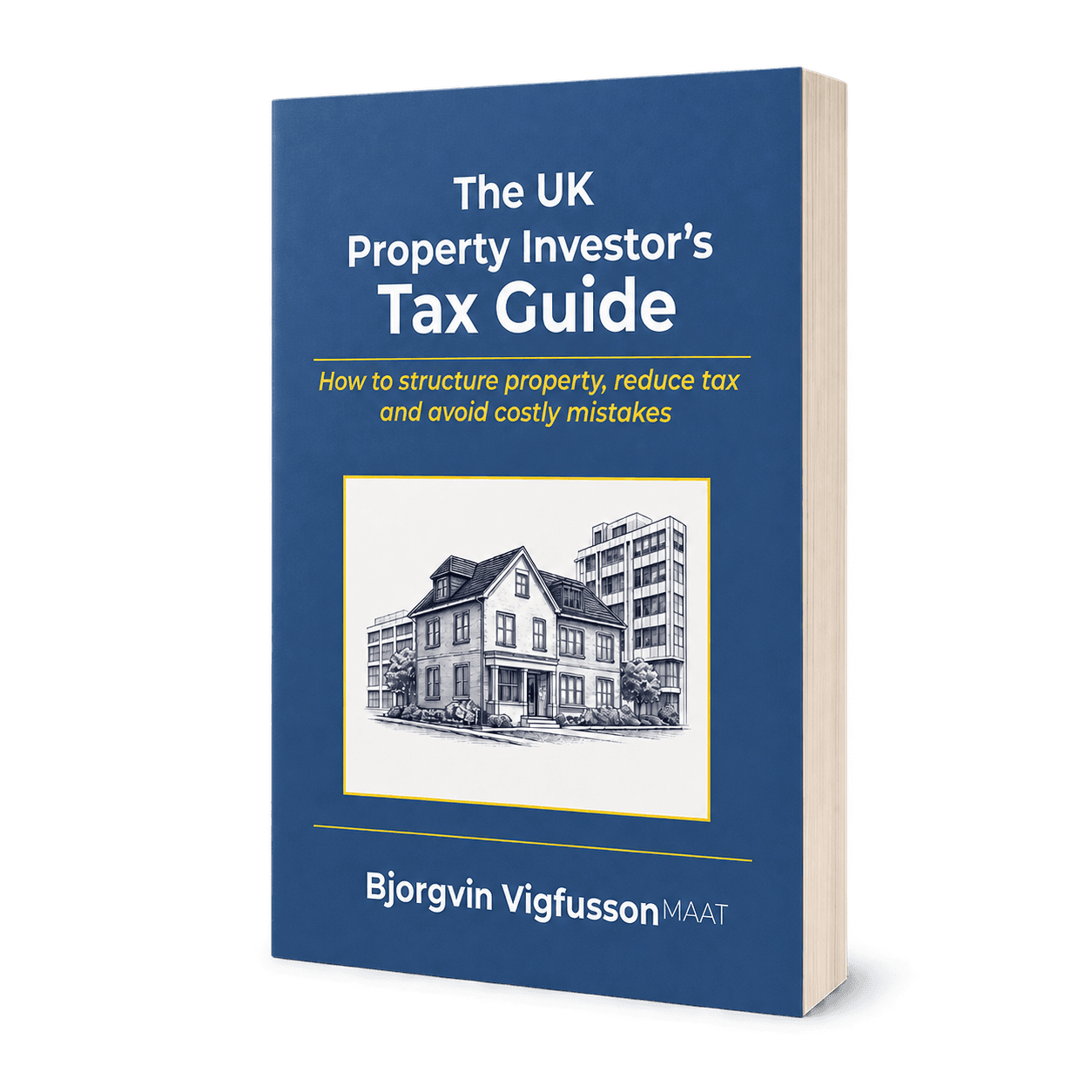
Written by Björgvin
The UK Property Investor's Tax Guide
How to structure property, reduce tax and avoid costly mistakes. A 15-chapter plain-English guide covering everything from choosing the right structure at the start to inheritance tax, SPVs and advanced group planning.
Service levels
Support shaped around your portfolio.
Three levels of property accounting support — each tailored to your portfolio on the call.
Comfort
Compliance & basic planning
For landlords who need clean, accurate compliance and a proactive accountant in their corner.
- Self-assessment tax return
- Rental income statements
- Allowable expense advice
- HMRC correspondence
- Year-round support
Reliance
Most popularActive portfolio management
For investors with multiple properties or an SPV structure who need regular reporting and proactive tax planning.
- Everything in Comfort
- SPV accounts & CT returns
- Capital gains tax planning
- Portfolio restructuring advice
- Quarterly planning reviews
- Stamp duty guidance
Growth
Development & complex portfolios
For developers and portfolio investors with complex multi-entity structures who need strategic financial oversight.
- Everything in Reliance
- Development project accounts
- CIS management
- Lender reporting
- Multi-entity tax structuring
- Exit & succession planning
Not sure which level fits? That's exactly what the free 20-minute call is for — we'll map your situation and recommend the right level. Your fixed fee is agreed on the call, not after it.
Book a free callCommon questions
Property accounting — your questions answered.
Everything you need to know before booking a call.
Not covered here? Ask us directly — we answer within 1–2 working days.
Do I need a specialist property accountant?
Property accounting has its own rules — allowable expenses, capital vs revenue treatment, Section 24, SPV structuring, CIS, VAT on construction and more. A general accountant may not be familiar with all of these, which can mean missed reliefs, incorrect classifications and higher tax bills. Specialist knowledge pays for itself.
Should I hold property personally or in a limited company?
It depends on your tax position, mortgage situation, portfolio size and long-term plans. There's no single right answer — but the decision has significant tax implications either way. We work through the numbers with you on the discovery call and give you a clear recommendation based on your specific situation.
How does Section 24 affect me and what can I do about it?
Section 24 restricts mortgage interest relief for individual landlords to the basic rate only — meaning higher and additional rate taxpayers can no longer deduct the full finance cost. For heavily geared portfolios this has significantly increased tax bills. We review your position and advise on the most effective response, which may include restructuring, incorporation or other planning.
What is an SPV and do I need one?
A Special Purpose Vehicle is a limited company set up specifically to hold property. It can be tax efficient for higher rate taxpayers because rental profits are taxed at corporation tax rates rather than income tax rates. Whether it's right for you depends on your circumstances — we'll advise on the call.
Can you handle both my personal tax and my property company accounts?
Yes — and this is one of the biggest advantages of working with Heights. We handle the full picture: your personal self-assessment, your SPV accounts and CT return, and any other entities in your portfolio. Everything is joined up, which means better tax planning across the board.
Do you work with property developers as well as landlords?
Yes — development accounting is a specialist area and one we're experienced in. The tax treatment of development profits differs significantly from rental income, and getting the revenue vs capital classification wrong can be extremely costly — as our £200,000 case study on this page demonstrates.
Do you advise on serviced accommodation and holiday lets?
Yes — serviced accommodation and holiday lets have their own tax rules, and these changed significantly in 2025 with the abolition of the Furnished Holiday Let regime. If you operate short-term lets, we can review your current position, advise on the new rules and make sure your structure and tax treatment are correct going forward.
I've read your book — do I need an accountant as well?
The book is designed to help you understand the decisions. An accountant helps you implement them correctly, avoid costly mistakes and make sure your specific situation is handled properly. Most readers find the two work well together — the book gives you the framework, the engagement puts it into practice.
Get started
Ready to get specialist property accounting?
Book a free 20-minute call with Björgvin. We'll review your portfolio, identify the key opportunities and agree a fixed fee — on the call, not after it.
- Free 20-minute call
- Fee agreed on the call
- No minimum contract
- CIMA & AAT qualified